
Assi Ghat aarti timings: morning Subah-e-Banaras and the evening aarti
· 6 min read
Assi Ghat aarti timings first: the morning aarti, Subah-e-Banaras, runs from 04:50 to 07:00 in summer and from 05:40 to 07:45 in winter. The evening aarti starts at sunset, so roughly 17:10 to 17:50 in winter and 18:00 to 18:50 in summer. Nobody prints a fixed clock time for the evening one, which is why you should be on the steps before the sun goes down.
Plenty of people search for it as the 80 Ghat aarti, since assi is Hindi for eighty. Same ghat. The morning times are the organisers' own, from their website, and we checked them again on 13 November 2026.
Assi Ghat aarti timings by season
| Aarti | Summer | Winter | Who says so |
|---|---|---|---|
| Morning: Subah-e-Banaras | 04:50 to 07:00 | 05:40 to 07:45 | The organisers' website |
| Evening aarti at Assi | At sunset, about 18:00 to 18:50 | At sunset, about 17:10 to 17:50 | Kashi's official portal says sunset; sunset times from sunrise-sunset.org |
| Evening aarti at Dashashwamedh, for comparison | About 19:00, lasts about 45 minutes | About 18:00, lasts about 45 minutes | The UP government's Pawan Path site |
Want the aarti as part of a planned Kashi day? WhatsApp or call 7233999686 with your hotel and date. We'll plan the day so you're on the steps before it starts.
Summer slot or winter slot?
Here's the awkward bit. The organisers print a summer slot and a winter slot, but not the date the clock flips from one to the other. Their home page only says the start shifts with the season and with dawn. If your trip lands in the weeks when the weather is turning, check with them the day before. Their phone numbers are on subahebanaras.net.
You'll also find rounder times on other travel sites. They don't match what the organisers publish, so we've gone with the organisers.
Month by month: the clock time follows sunrise and sunset
Both aartis move with the sun. Here's Varanasi's sunrise and sunset on the 15th of each month in 2026, and the dawn slot we'd plan for. The organisers don't publish the switch date, so that last column is our reading of the sunrise, not their word.
| Month | Sun's up at | Sun's down at (be on the steps before) | Dawn slot we'd plan for |
|---|---|---|---|
| January | 06:45 | 17:29 | winter one, so 05:40 |
| February | 06:33 | 17:52 | winter one, so 05:40 |
| March | 06:07 | 18:07 | could be either, ring first |
| April | 05:36 | 18:21 | summer one, so 04:50 |
| May | 05:13 | 18:36 | summer one, so 04:50 |
| June | 05:07 | 18:50 | summer one, so 04:50 |
| July | 05:17 | 18:51 | summer one, so 04:50 |
| August | 05:32 | 18:34 | summer one, so 04:50 |
| September | 05:44 | 18:03 | summer one, so 04:50 |
| October | 05:56 | 17:31 | could be either, ring first |
| November | 06:15 | 17:10 | winter one, so 05:40 |
| December | 06:36 | 17:10 | still winter, 05:40 |
Don't treat these as exact for your date, they creep a little each day before and after the 15th. March and October are the tricky ones. We honestly can't tell you which slot they'll be running, so drop the organisers or us a message the day before. Sunrise and sunset figures are from sunrise-sunset.org for Assi Ghat, read in October 2026.
What happens at dawn
Subah-e-Banaras began on 24 November 2014. The district magistrate of the time set it up with the Regional Cultural Centre, and these days a committee runs it. It happens every single day, before sunrise, and takes about 2 hours. The stage is at New Asi Ghat, a short walk along the river from the main Assi steps.
It's less one ritual than a little sequence. Vedic hymns come first, then the aarti offered to the rising sun, then a yagya, which is a fire offering, a morning raga, and yoga at the end. Plenty of people stay for the aarti and wander off for chai after. You won't be the only one.
Seats can be booked on their site. When we looked, the booking page asked ₹200 for a standard seat and ₹300 for a premium one. What it doesn't tell you is whether standing on the ghat steps costs anything, so if you plan to just turn up, ask at the ghat rather than going on our word.
Assi or Dashashwamedh?
Varanasi's official tourism portal says Assi's evening aarti is like the one at Dashashwamedh, only calmer and less crowded. Our drivers would agree. Dashashwamedh is the big show with the crowd to match, and at Assi you can usually see without standing on tiptoe.
Nobody publishes the Assi evening time, so we treat it like Dashashwamedh's, which the UP government's Pawan Path site ties to sunset. Be on the steps before the sun goes down and you won't miss the start.
If you've only got one early morning in the city, give it to Assi, because that's where Subah-e-Banaras is. Then keep an evening free for Dashashwamedh. Our blog has a separate Ganga aarti guide on when to arrive there and where to sit.
Where to stand, or watch from a boat
Assi is the first of the old ghats of Banaras, at the southern end of the old city, sitting where the little Asi stream meets the Ganga. Tulsidas lived in a cave here, wrote the Ramcharitmanas here and died here, so pilgrims were coming long before anyone thought of a dawn programme.
On the steps, turn up a bit before the start and grab a spot facing the platform. In winter bring a shawl. The stone is properly cold at that hour and you'll be sitting on it.
For the evening, the Pawan Path site tells people to reach Dashashwamedh by 17:00 if they want to be close. Assi is calmer and you rarely need that much of a head start, but do get there before sunset and sit near the front of the steps, facing the river.
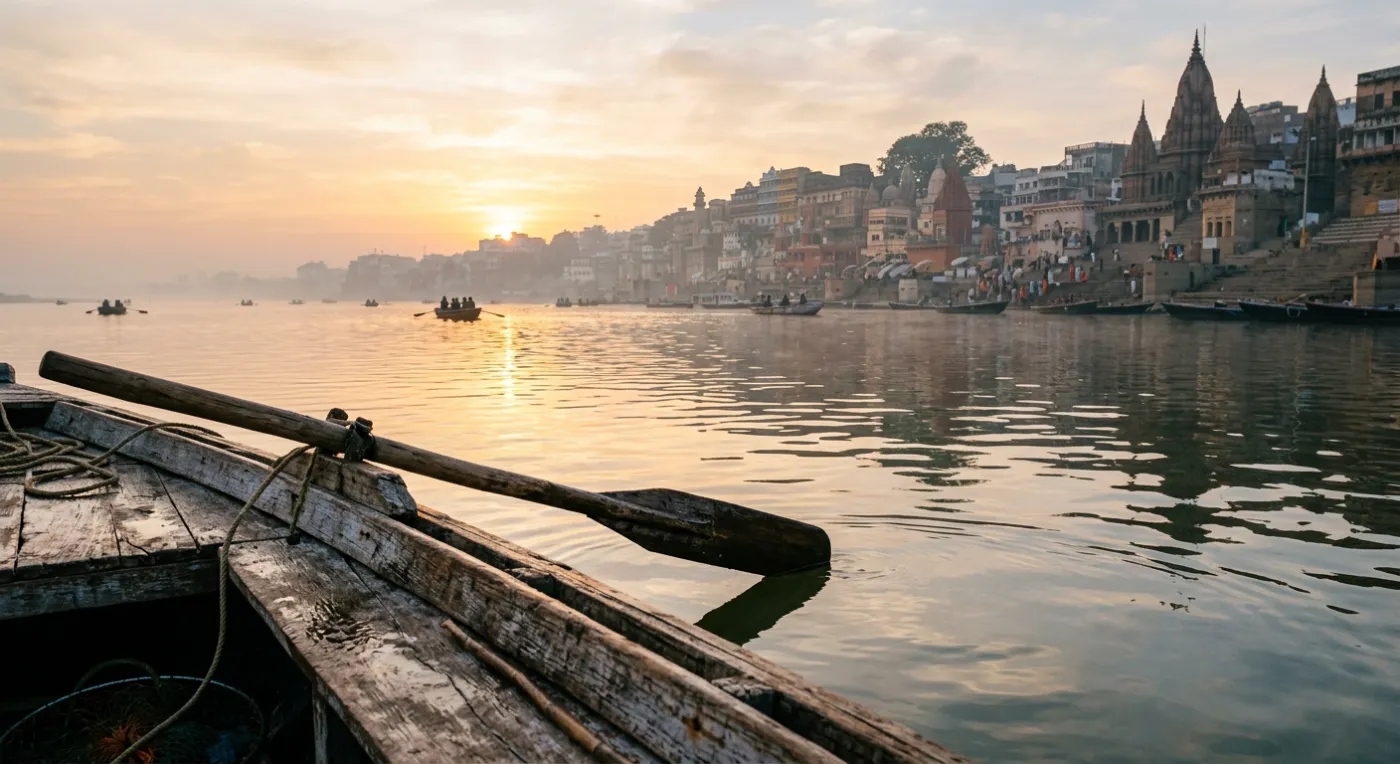
From a boat it's quieter, and you get the river and the sky in one frame, which is really the whole point at sunrise. The catch is distance. The hymns reach you faintly and you won't see faces.
Getting to Assi before dawn
| Starting from | Road distance to Assi Ghat |
|---|---|
| Varanasi Junction railway station | 6.1 km |
| Varanasi airport | 27.8 km |
| Godowlia crossing | 2.7 km |
Before dawn the roads are almost empty, and our drivers allow 20 minutes from most Cantt hotels to the river. The airport is a proper drive, so if you're flying in, land the day before and sleep near the ghats. Cars don't go down to the water. Your driver stops up top and you walk the last stretch, so wear shoes that grip on damp stone.
A morning that fits: boat, then yoga at Assi
Our Sunrise Boat & Yoga Morning costs ₹1,999 per person. We pick you up at 05:15 and you're on a shared rowing boat at Dashashwamedh by 05:45. From 06:00 you go downstream past Manikarnika as the light comes up, then back upstream to Assi. At 07:15 you step ashore at Assi for an hour of yoga with an instructor, and you're back at the hotel around 08:30. The boat is 90 minutes long. Bottled water and the hotel pickup and drop are included, breakfast isn't.
To be straight with you, this morning isn't built around Subah-e-Banaras. In summer the programme has finished by 07:00, before we land. In winter it runs to 07:45, so you'll reach Assi while it's still going, near the end. If the aarti is what you really came for, message us on WhatsApp and we'll time the pickup so you're on the steps before it starts.
Book the sunrise morning on WhatsApp at 7233999686. Ask for the Sunrise Boat & Yoga Morning and tell us whether to time the pickup to Subah-e-Banaras.
The mistake we see most? Booking a 07:30 boat because it sounds kinder on the alarm clock. By then the sun's up and the best part of the morning has gone. Go early, or honestly, have a lie-in instead.
Common questions
What is the Assi Ghat aarti time today?
It depends on the season. The morning aarti starts at 05:40 on a winter day and 04:50 on a summer day. The evening one starts at sunset, which in mid-November is about 17:10 and in mid-June about 18:50. Around March and October, ring the organisers the day before.
What is the morning Ganga aarti time in Varanasi?
At Assi Ghat it's Subah-e-Banaras. Going by the organisers' website, it runs 04:50 to 07:00 in summer and 05:40 to 07:45 in winter. The start moves with dawn, so near a change of season, check with them the day before.
Is there an evening aarti at Assi Ghat?
Yes. Varanasi's official portal lists one and calls it calmer and less crowded than Dashashwamedh's. It starts at sunset rather than at a printed time, so roughly 17:10 to 17:50 in winter and 18:00 to 18:50 in summer. Be on the steps before the sun goes down.
How much does Subah-e-Banaras cost?
Their booking page shows ₹200 for a standard seat and ₹300 for a premium one. It doesn't say whether standing on the ghat steps is free, so if you're turning up without a booking, ask at the ghat.
How long does Subah-e-Banaras last?
About 2 hours. It goes from Vedic hymns to the aarti to the rising sun, then a yagya, a morning raga and yoga. Lots of people come for the aarti and drift off once it's done.
Should I see the aarti at Assi Ghat or Dashashwamedh?
Do both if you've got two days. Assi at dawn for Subah-e-Banaras, Dashashwamedh in the evening, when the UP government's Pawan Path site puts its aarti at about 18:00 in winter and 19:00 in summer.
How far is Assi Ghat from Varanasi station and the airport?
It's 6.1 km by road from Varanasi Junction and 27.8 km from the airport. The roads are clear before dawn. Just book your car the night before so you aren't hunting for an auto in the dark.
Planning this trip?
Send your dates and group size and we will build an itinerary around them.
From our group
- Varanasi On WheelsFixed airport fares and outstation routes by cab or tempo traveller.
- Kashi TempoTempo travellers and buses from 12 to 49 seats, on a printed per-km rate card.
- World View Travel ServicesOur parent company, in Varanasi since 1992.
- Urbania Varanasi CabsForce Urbania and Maharaja Urbania only, timed around temple darshan.